
Building a Multi-Tenant SaaS
Many enterprise teams underestimate how different building a multi-tenant SaaS is from creating a custom internal application. On paper, both involve cloud infrastructure, APIs, databases, and CI/CD pipelines. However, the risk profile, architectural discipline, and operational rigor are on entirely different levels.
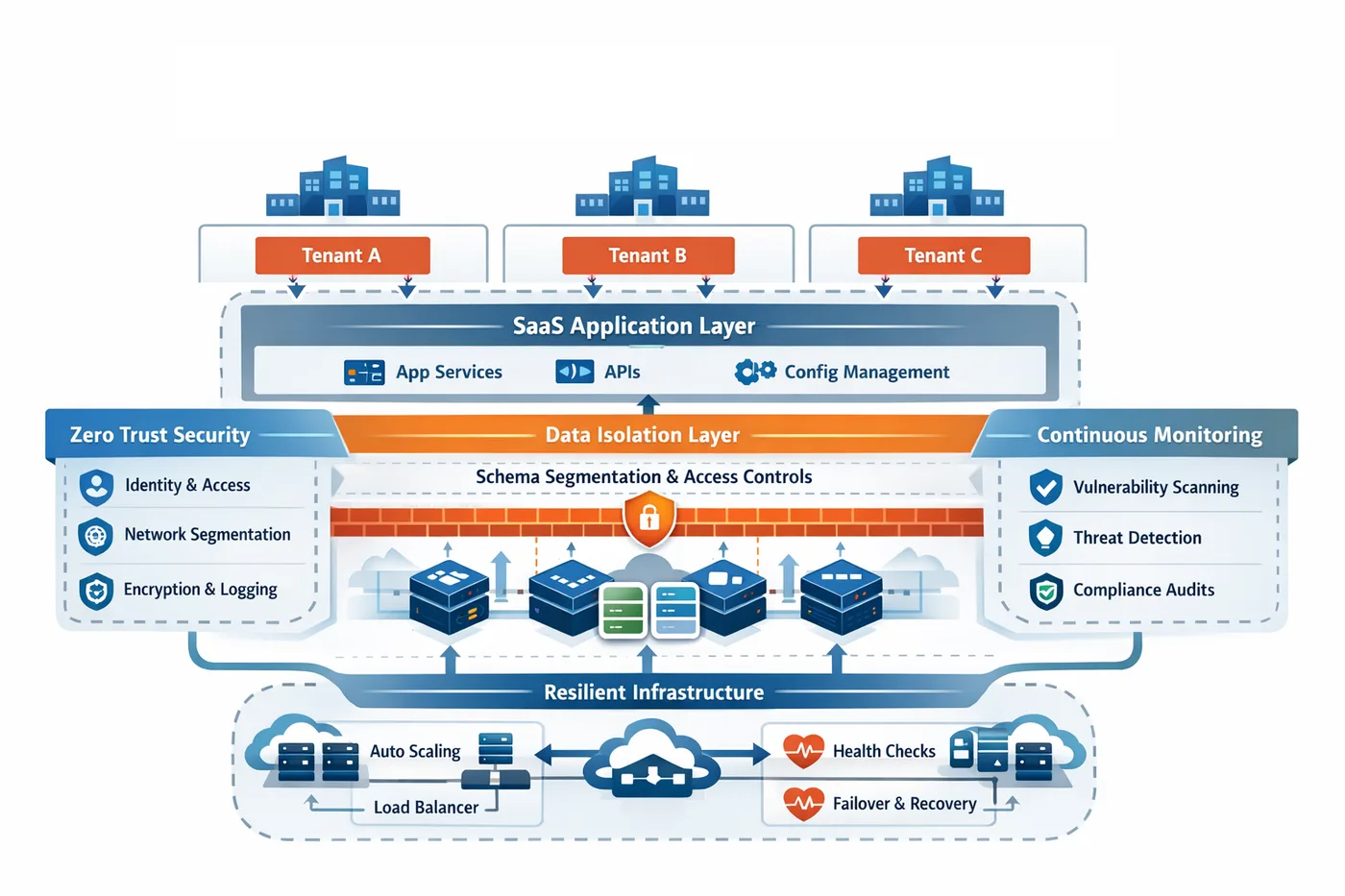
While building a multi-tenant SaaS, four areas consistently drive complexity, cost, and engineering time:
- Data isolation
- Zero Trust networking
- Resilience and auto-scaling
- Continuous security and observability
These are not edge cases. They are the core problem space of multi-tenant platforms.
Below are the key lessons learned and what organizations should do differently when moving from internal systems to SaaS platforms.
1. Data Isolation Is No Longer an Environment Problem
Enterprise internal apps often rely on environment-level isolation:
- Separate VPCs
- Separate accounts
- One database per system
- Trust enforced by network boundaries
This approach breaks down immediately in multi-tenant SaaS.
What Changed in SaaS
In a SaaS platform, data isolation must be enforced inside the application and database layers, not by infrastructure alone. Every query, every transaction, and every session must be tenant-aware.
In our SaaS, the most time-consuming architectural decision was database isolation:
- We chose separate schemas per tenant.
- Tenant context is resolved at session initialization.
- Data sources are dynamically mapped per user session.
- Cross-tenant access is blocked by design, not by convention.
This took longer than expected, but it eliminated entire classes of risk.
Lesson Learned
If tenant isolation is not structural, it will eventually fail.
What Organizations Should Do
Make tenant context a first-class primitive, not a request attribute.
Enforce tenant scoping at:
-
ORM level
-
Stored procedures
-
Migration tooling
Assume that a single missed WHERE clause is a breach, not a bug.
This aligns directly with Zero Trust thinking: never rely on implicit boundaries.
2. Zero Trust Networking Adds Complexity but Removes Fragility
Internal enterprise apps often assume:
- Flat or semi-flat networks
- Broad east-west access
- Static trust relationships between services
That model does not scale safely in SaaS.
What Changed in SaaS
We designed our SaaS using Zero Trust networking principles:
- Explicit service-to-service trust
- Minimum required ports only
- No implicit subnet trust
- Tight security groups and routing rules
This created complexity:
- More configuration
- More troubleshooting
- More upfront design effort
But it also produced a system where compromise does not cascade.
Lesson Learned
Zero Trust networking is hard to design, even harder to implement, but easier to survive.
What Organizations Should Do
Treat networking as an authorization problem, not a connectivity problem.
Explicitly model:
-
Who can talk to whom
-
On what port
-
For what purpose
Design for breach containment, not breach prevention alone.
In multi-tenant SaaS, blast radius matters more than elegance.
3. Resilience and Auto-Scaling: The Backbone of SaaS
An internal app is sized for a user base you know. A SaaS platform is not so lucky.
What Changed in SaaS
In a multi-tenant environment, demand is the sum of every tenant's busy periods, and it is hard to predict. The system has to scale up and down on its own. We implemented:
- Automated scaling based on real-time metrics.
- Health checks to monitor the status of services.
- Load balancing to distribute traffic evenly across instances.
Lesson Learned
A resilient system is not just about uptime; it’s about maintaining performance under stress.
What Organizations Should Do
- Invest in monitoring tools that provide real-time insights.
- Implement auto-scaling policies that align with usage patterns.
- Regularly test the system's resilience through chaos engineering.
4. Security Is Continuous or It Is Fiction
Internal applications often treat security as:
- Periodic scans
- Annual assessments
- Point-in-time compliance
That approach collapses under SaaS scale.
What Changed in SaaS
Security became continuous by necessity:
- Automated vulnerability scanning in CI/CD.
- Policy enforcement before deployment.
- Cloud security posture monitoring.
- Application and infrastructure logging.
- Alerting tied to behavior, not just failures.
This required real investment in DevSecOps maturity—not just tooling, but process and accountability.
Lesson Learned
In SaaS, security debt compounds faster than technical debt.
What Organizations Should Do
Treat CI/CD as a security control plane.
Automate:
-
Dependency scanning
-
Image hardening
-
Configuration drift detection
Centralize logs, but segment them by tenant.
Alert on indicators of compromise, not just outages.
Security in SaaS is not about preventing every issue; it’s about detecting, containing, and responding faster than the impact.
The Bigger Difference: Product Platforms vs Projects
The most important lesson is this:
A multi-tenant SaaS is not a bigger custom app. It is a product platform with operational accountability.
Internal enterprise systems optimize for:
- Known users
- Known workloads
- Known risk tolerance
SaaS platforms must optimize for:
- Unknown usage patterns
- Unknown threat actors
- Shared fate across customers
That difference changes every architectural decision.
Closing Perspective when Building a Multi-Tenant SaaS
At Zephon, we’ve learned that security, resilience, and tenant isolation cannot be retrofitted into SaaS platforms. They must be designed in from day one, guided by Zero Trust principles and operational realism.
The payoff is worth it:
- Lower long-term risk
- Faster scaling without fragility
- Higher customer trust
- Fewer existential failures
For organizations considering the jump from internal systems to SaaS, the key question is not “Can we build it?” It is “Are we ready to operate it securely, continuously, and at scale?”
That distinction makes all the difference.